
Fountain Pen Ink Guide
Fountain pen ink is what gives a fountain pen its colour and keeps the writing flowing onto the page. Unlike many other types of pen ink, fountain pen ink is made to flow through a pen’s feed and nib without needing much pressure. It comes in many colours and types, so choosing the right one can feel confusing at first. This fountain pen ink guide explains the basics in simple terms, including ink types, colours, flow, drying time, water resistance, and how to choose and care for your ink. Whether you are buying your first bottle or trying a new colour, you will learn what to look for before filling your pen.
Understanding Fountain Pen Ink Types
Not all fountain pen ink behaves the same way once it hits the page, and the difference usually comes down to what’s actually in the bottle. Three important types worth knowing are dye-based, pigment, and iron gall ink. Each has its own strengths, quirks, and things to watch out for.
Dye-Based Ink
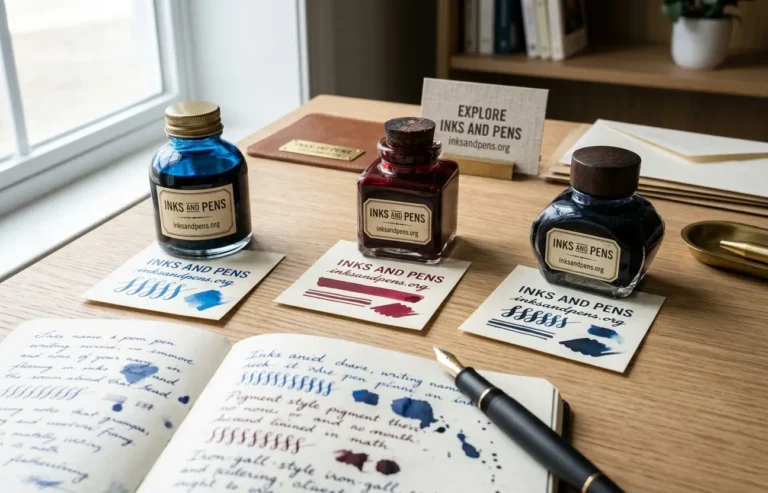
If you’ve never bought fountain pen ink before, there’s a good chance the first ink you come across will be dye-based. The colour comes from dye fully dissolved in the liquid, which is one reason these inks are often easy to use and clean. They also come in a huge range of colours, with some formulas showing interesting effects like shading and sheen. How strong those effects look can depend a lot on the pen, ink, and paper you use together.
Pigment Ink
Pigment ink works differently. The colour comes from tiny particles suspended in the liquid rather than dye dissolved into it. Some pigment inks offer better resistance to water and fading, which can be useful when you need writing to last. The trade-off is that some pigment inks can be more demanding to clean, especially if the ink is allowed to dry inside the pen. Cleaning the pen when needed helps reduce the chance of dried ink causing problems.
Iron Gall Ink
Iron gall ink has been used for centuries, long before fountain pens existed. Modern iron gall inks made for fountain pens are formulated to be gentler than the traditional versions used for historical writing. One of their interesting features is how the colour can change as the ink dries. It may look lighter when first written and become darker as it dries, while also offering good water resistance. Because of its chemistry, iron gall ink deserves a little more care than a standard dye-based ink, especially if you are leaving a pen unused.
Fountain Pen Ink Properties
Two inks can look almost identical in the bottle but behave very differently on paper. A few key properties explain most of those differences. Understanding them before you buy can help you choose an ink that fits the way you write.
|
Ink Property |
What It Means |
Why It Matters |
|
Drying Time |
How long the ink takes to dry on paper |
Helps reduce smudging when writing quickly |
|
Shading |
Light and dark variations within the same ink colour |
Adds depth and character to handwriting |
|
Sheening |
A second colour that appears over the main ink colour |
Creates a striking effect on suitable paper |
|
Water Resistance |
How well the writing remains readable after contact with water |
Useful when writing needs extra protection |
Drying Time
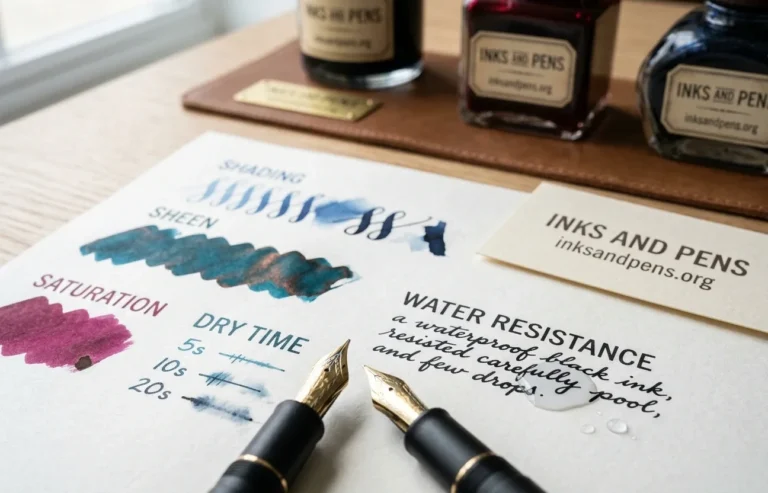
Drying time is the amount of time fountain pen ink needs before it stops smearing on the page. Paper, nib size, ink flow, and the amount of ink on the page can all affect how quickly it dries. If you’re left-handed or tend to write quickly, a faster-drying ink can be easier to use because there is less chance of your hand dragging through wet writing.
Shading and Sheening
Shading and sheening are often confused, but they create different effects. Shading appears when the same ink colour becomes lighter or darker in different parts of a stroke, usually because more ink collects in some areas. Sheening happens when a second colour appears over the main ink, especially where the ink is more concentrated. Both effects depend on the ink, nib, and paper, so an ink that looks dramatic in one notebook may look much more subtle in another

Water Resistance
Water resistance describes how well fountain pen ink stays readable when it comes into contact with water. Some inks can wash away quickly, while others leave enough colour behind to keep the writing legible after a spill. Water resistant and waterproof are not necessarily the same thing, and these terms can vary between manufacturers. If you plan to use an ink for important writing, test it on your usual paper before relying on it
Choosing Ink for Different Writing Needs
There’s no single “correct” ink, just the one that fits what you’re actually about to write. A colour that’s perfect for a journal can be the wrong pick entirely for something that needs to survive years in a filing cabinet.
- Everyday Writing: Keep it simple. A reliable blue or black that flows well and doesn’t demand special cleaning is all daily notes and lists need.
- School and Study Notes: Since you’re often writing fast and reviewing pages later, prioritize an ink that behaves well at a quick pace rather than one chosen purely for looks.
- Journaling: This is the one place where practicality can take a back seat. Pick based on how the colour makes you feel about writing, not on how it performs under stress it will never actually face.
- Work and Professional Writing: Stick to conventional colours for anything official, and consider how the document will be stored or handled before picking a bottle.
- Signing Important Documents: Some contracts and legal forms specify what kind of ink is acceptable, so it’s worth checking before you reach for whatever is already in your pen.
- Left-Handed Writing: Your hand passes back over what you just wrote more than a right-hander’s does, so it’s worth running a quick test with your actual pen and paper before committing to a bottle.
- Creative Writing and Lettering: A wetter or broader nib tends to bring out an ink’s personality more than a fine one does, so keep that in mind if you’re chasing a specific visual effect.
How to Store and Use Bottled Ink
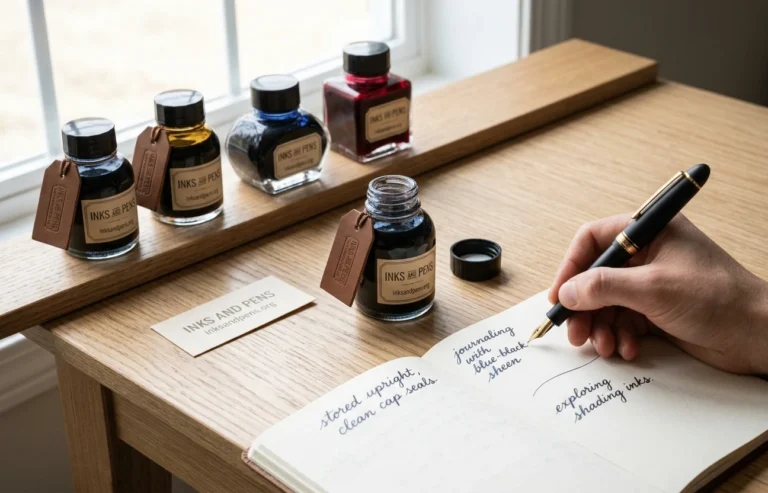
Bottled ink doesn’t need much fuss, but a little care saves you from some annoying problems later. Keep the cap closed when you’re done and store the bottle somewhere cool and away from direct sunlight. When filling your pen, it’s a good idea to put the bottle on a surface that can handle a stray drop of ink because spills happen, especially when you’re still getting used to filling a fountain pen. Try to keep the nib and bottle opening clean, too. If ink builds up around the bottle’s neck, wipe it away before it dries and becomes difficult to clean. And if you know you won’t be using a pen for a while, clean the ink out first. Leaving ink sitting inside an unused pen can turn a simple storage job into a much bigger cleaning task later.
Ink Compatibility With Different Pens
The same bottle of fountain pen ink can behave differently depending on the pen you’re using. A fine nib may put down a thin, controlled line, while a broad or wetter nib can make the same ink look darker and show more of its shading or sheen. Your pen doesn’t need a special ink for every situation, but matching the ink to the way you use the pen can make writing much more enjoyable.
|
Pen Type or Writing Situation |
Ink Choice to Consider |
What to Expect |
|
Everyday fountain pen |
Well-behaved dye-based ink |
Easy to use for regular writing and generally straightforward to clean |
|
Fine nib |
A well-flowing ink that is not overly wet |
Helps keep fine lines neat and prevents the page from looking too saturated |
|
Broad or wet nib |
Ink with shading or sheening properties |
More ink reaches the paper, which can make colour variation easier to notice |
|
Demonstrator or clear pen |
A clean, easy-to-maintain ink |
The ink is visible inside the pen, so colour and cleanliness are easier to notice |
|
Pen used only occasionally |
An ink that is easy to clean |
Makes it simpler to put the pen away without leaving it filled for long periods |
|
Pen used for longer writing sessions |
Smooth, well lubricated ink |
Can make the writing feel more comfortable, especially with frequent use |
|
Pen for notes that may get wet |
Ink with suitable water resistance |
Gives the writing a better chance of staying readable after contact with water |
One simple rule is worth keeping in mind: use fountain pen ink that is intended for fountain pens. If you’re unsure about a specialty ink, check the manufacturer’s guidance before putting it into your pen. This is especially useful when you’re trying an ink with unusual properties rather than a standard everyday formula.
FAQ
Final Thoughts
Choosing fountain pen ink gets much easier once you know what actually matters. You don’t need to understand every ink formula or try dozens of colours before finding one you like. Start with how you write, the pen you use, and whether things like quick drying, shading, or water resistance matter to you. From there, it’s mostly a matter of trying an ink and seeing how it feels on your usual paper.
A simple everyday ink is often enough to get started. Once you’re comfortable with that, you can have fun trying different colours and effects. And if an ink doesn’t work well in your pen, don’t assume you’ve done something wrong. Sometimes the ink, pen, and paper simply don’t get along.